So, you're thinking about buying a lab-grown diamond. Maybe the price caught your attention, or you've found that sparkling diamond stone you really like. Either way, it's worth knowing a little more before you spend your money.
A lower price sounds great, but it doesn't answer every question. You still need to know how the diamond compares in quality, whether you could resell it later, and whether choosing one really makes a difference to your styling.
These are all worth thinking about before making a decision. Let's look at what lab-grown diamonds offer, where they have their limitations, and what you should know before choosing one in 2027.
What Is a Lab-Grown Diamond?
A lab-grown diamond is a real diamond made in a laboratory rather than formed naturally deep inside the Earth. It has the same basic properties as a natural diamond, but the difference is how it's created.
Natural diamonds take millions to billions of years to form under the right conditions underground. Scientists have found ways to recreate those conditions in a lab, allowing diamonds to grow in a much shorter time.
There are two main ways to make lab-grown diamonds:
HPHT (High Pressure, High Temperature): This method uses very high pressure and heat to create the conditions a diamond needs to grow. A small diamond seed is used to start the process, and the diamond gradually develops around it.
CVD (Chemical Vapor Deposition): This method works a little differently. A small diamond seed is placed inside a special chamber containing carbon-rich gas. Over time, carbon builds up on the seed and forms a diamond.
Both methods can produce real diamonds used in jewelry. So, even though lab-grown diamonds are made differently from natural ones, they are real diamonds rather than imitations, just created in a different environment.
Why Do People Choose Lab Grown Diamonds Over Natural Ones?
There are several reasons people choose lab-grown diamonds, but the lower price is usually the biggest one. They also take much less time to grow than natural diamonds, which form deep inside the Earth over millions or even billions of years.
Lab-grown diamonds offer the same basic properties as natural diamonds, often at a much more affordable price, making them an appealing option for buyers who want a real diamond without spending as much.
They cost less. Lab-grown diamonds can be considerably cheaper than natural diamonds with comparable characteristics. For example, CaratRadar's price tracker currently lists an average 1-carat natural diamond at about $3,441 and an average 1-carat lab-grown diamond at about $644. That's a difference of about 81%. However, prices vary between retailers, so these figures shouldn't be treated as fixed market prices.
You can get a larger stone. With the same budget, you may be able to choose a larger lab-grown diamond instead of a smaller natural one. A $5,000 budget, for example, could give you more size options in the lab-grown market, depending on the stone and setting you choose.
High grades are widely available. Lab-grown diamonds are often available in high color and clarity grades. That gives buyers plenty of options, although the actual appearance and quality still depend on the individual stone.
They're durable. Because lab-grown diamonds are real diamonds, they have the same fundamental hardness as natural diamonds. They're suitable for everyday jewelry, including engagement rings, when properly set and cared for.
They avoid diamond mining. If you'd prefer not to buy a diamond extracted from the earth, lab-grown stones offer another option. However, avoiding mining doesn't automatically mean the diamond has a lower environmental footprint. That depends partly on how it's produced.
Another advantage is that you can explore different designs before making a decision. With a ring try on tool, for example, you can preview different diamond shapes and ring styles on your own hand. This can help you decide what you like before spending money on the actual ring.
Why Some Jewelers Won’t Buy Them at All
Getting a real diamond for less money sounds like a great deal, right? But what happens if you want to sell it a few years later? That's where things get a little tricky with lab-grown diamonds.
While they're more affordable to buy, getting your money back can be difficult, and some jewelers won't buy them at all. So, before you make a decision, it's worth understanding a few of the downsides.
1. Resale value can be low. If you plan to sell the diamond later, you may receive much less than you originally paid. Some jewelers also refuse to buy back lab-grown diamonds.
2. Prices have fallen sharply. New lab-grown diamonds have become cheaper as production has expanded and manufacturing has improved. This means a stone you buy today could compete with a similar new stone selling for less in the future.
3. They're not rare in the same way as natural diamonds. Natural diamonds formed through geological processes over extremely long periods. Lab-grown diamonds can be produced in controlled facilities, so their supply can respond differently to demand and manufacturing costs. This difference affects how buyers value them.
4. Not everyone prefers them. Some buyers place particular importance on a diamond's natural origin, rarity, or tradition. Surveys about these preferences should be read carefully, especially when they're commissioned by industry groups with a financial interest in the results. Still, personal preference matters when you're buying jewelry.
5. Prices can vary considerably between retailers. Two sellers may list diamonds with similar grading details at very different prices. Differences in stock, pricing strategies, and the individual stones can all contribute. Comparing several sellers is worth the time.
None of these points means you shouldn't buy a lab-grown diamond. They simply mean you should understand what you're paying for and what you can reasonably expect from the purchase.
Let’s Talk About Resale Value (What Should You Expect?)
Here’s the most awkward part: if you sold the diamond tomorrow, you wouldn’t get back what you paid at the store. That’s true for natural diamonds too, but lab-grown ones take a bigger hit.
According to Liori Diamonds’ guide to lab-grown diamond resale value, lab-grown diamonds may resell for around 20% to 40% of their original purchase price, while natural diamonds may retain around 50% to 60%. These are estimates published by a jewelry retailer, not guaranteed resale values, and actual offers can vary.
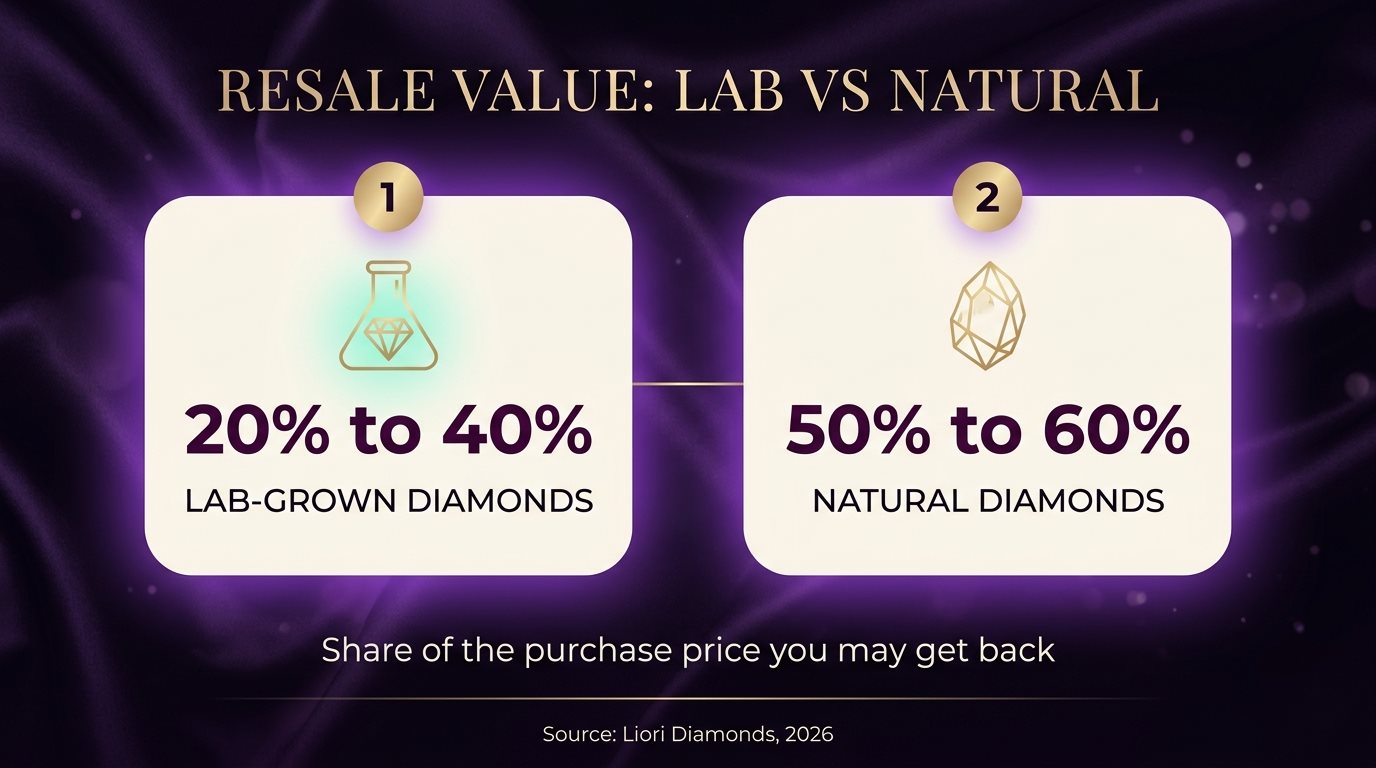
Source: Liori Diamonds
For example, if you bought a lab-grown diamond for $1,000, you might receive around $200 to $400 when selling it later. You could get less, depending on the stone and where you sell it.
Finding a buyer can also be difficult. Some jewelers won't buy lab-grown diamonds back at all, while others may offer a price based on current market conditions rather than what you originally paid. Some retailers offer trade-in or upgrade programs, but the terms vary.
Before buying, check the retailer's buyback or upgrade policy. If you think you might want to sell or upgrade your diamond in the future, ask exactly how the program works and get the terms in writing.
Where Are Lab-Grown Diamond Prices Heading?
If you're thinking about buying a lab-grown diamond, you've probably noticed that prices are much lower than they used to be. And the trend hasn't stopped. Over the past few years, lab-grown diamond prices have fallen sharply, making them more affordable for buyers.
In fact, a June 2026 report from BR Diamonds shows that a one-carat lab-grown diamond that sold for around $3,410 in January 2020 was priced at roughly $409 in early 2026. That's a drop of about 88%. Actual prices vary depending on the diamond's quality, shape, and retailer, but the example shows just how much the market has changed.
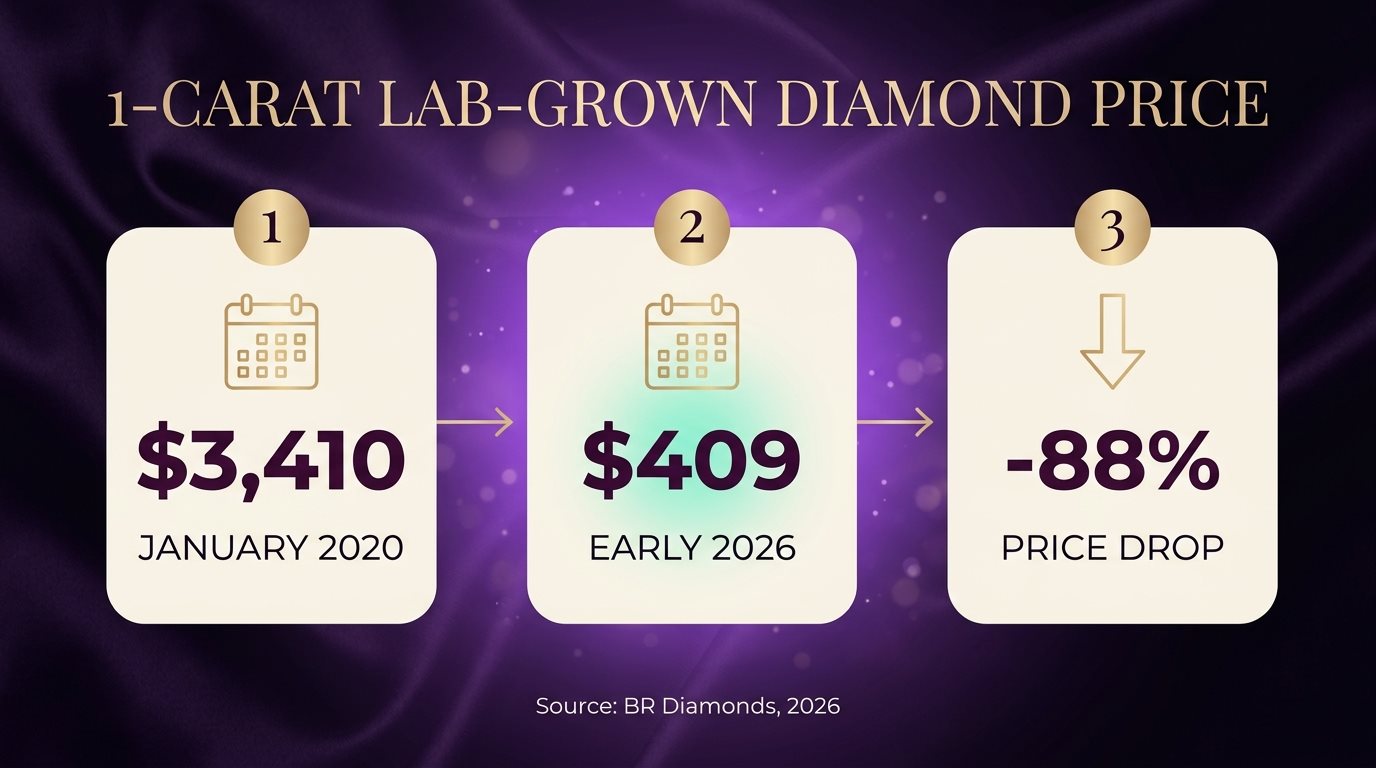
Source: BR Diamonds
Prices keep falling mainly because of supply. More companies can now produce lab-grown diamonds, and production capacity has increased significantly. When more diamonds become available but demand doesn't grow at the same pace, sellers often lower prices to stay competitive.
For buyers, that means you may be able to find a larger stone or explore more designs without spending as much. But it also means lab-grown diamonds aren't necessarily a good choice if you're hoping to sell them later for close to what you paid.
Are Lab-Grown Diamonds Worth Your Money in 2027?
The short answer is yes, if you're buying for the right reasons. Lab-grown diamonds offer the same basic properties as natural diamonds at a much lower price, giving you more room to choose the size and style you want.
However, they're not ideal for everyone. Prices may continue to change, and you might get much less than you paid if you sell later. If you're buying mainly as an investment, think carefully before making a decision.
But if you want a beautiful diamond to wear and enjoy for years, a lab-grown stone can be a sensible choice. Compare prices, check the grading report, and choose a diamond you're happy with.
So, buy a diamond for what it offers you today, not because you expect its value to grow tomorrow. No one knows exactly what the future holds. Natural diamonds may become scarcer, or lab-grown diamonds may continue to grow in popularity. Trends and prices can change, so choose the diamond that fits your budget and what matters most to you right now.
A Quick Review
Whether you choose a natural or lab-grown diamond, the best choice depends on your budget, preferences, and priorities. Take time to compare your options and understand what you're buying.
If you're planning to make your diamond part of your everyday life in the form of jewelry, like an engagement ring, it's worth finding a design you'll love for years to come. Try our Virtual Ring Try on to see how different rings look on your own hand and find a style that feels right for you.
FAQs
Are lab-grown diamonds real?
Yes, lab-grown diamonds have essentially the same chemical composition and crystal structure as natural diamonds. They are different from imitations such as cubic zirconia and moissanite.
Will a lab-grown diamond sparkle as much as a natural one?
A well-cut lab-grown diamond can show the same basic types of brightness, fire, and scintillation as a well-cut natural diamond. The individual stone's cut and characteristics matter more than its origin alone.
Can I sell a lab-grown diamond later?
Possibly, but you shouldn't assume you'll recover much of the original price. Some jewelers don't buy back lab-grown diamonds, and offers depend on the current market and the individual stone.
Is it safe to buy a lab-grown diamond online?
It can be, provided you choose a reputable seller, verify the grading report, review the return policy, and check that the listing describes the actual diamond accurately.
Is an IGI report better than a GIA report?
Not automatically, since the reports may use different assessment formats. IGI's traditional 4Cs grading can make direct comparisons easier for buyers who want individual color and clarity grades, while GIA uses a revised assessment for eligible lab-grown diamonds. Check what each report actually tells you.
Will lab-grown diamond prices rise in 2027?
There's no reliable way to guarantee that. Prices depend on production costs, supply, competition, demand, and retailer pricing. Treat predictions as possibilities, not promises.
Find Your Perfect Ring in Seconds
Stop guessing and start seeing. Our AI-powered virtual ring checker analyzes your preferences to reveal the perfect diamond for you. It's fast, fun, and finds your fit.
Try Our AI Checker Now