
A gorgeous ring that looks perfectly placed on your finger can seriously fool you on screen. Looking good doesn't mean it's your size, and you should know this before you place an order. Your real size comes down to stuff a photo can't grab: actual finger measurements, band width, even how your fingers shift throughout the day.
So how does a virtual ring try-on land on a size, and how much should you trust it?
This guide covers how the sizing works, how it compares to real fit, and what to check before you order.
Let's get into it!
Can a Virtual Ring Try-On Really Show the Exact Size?
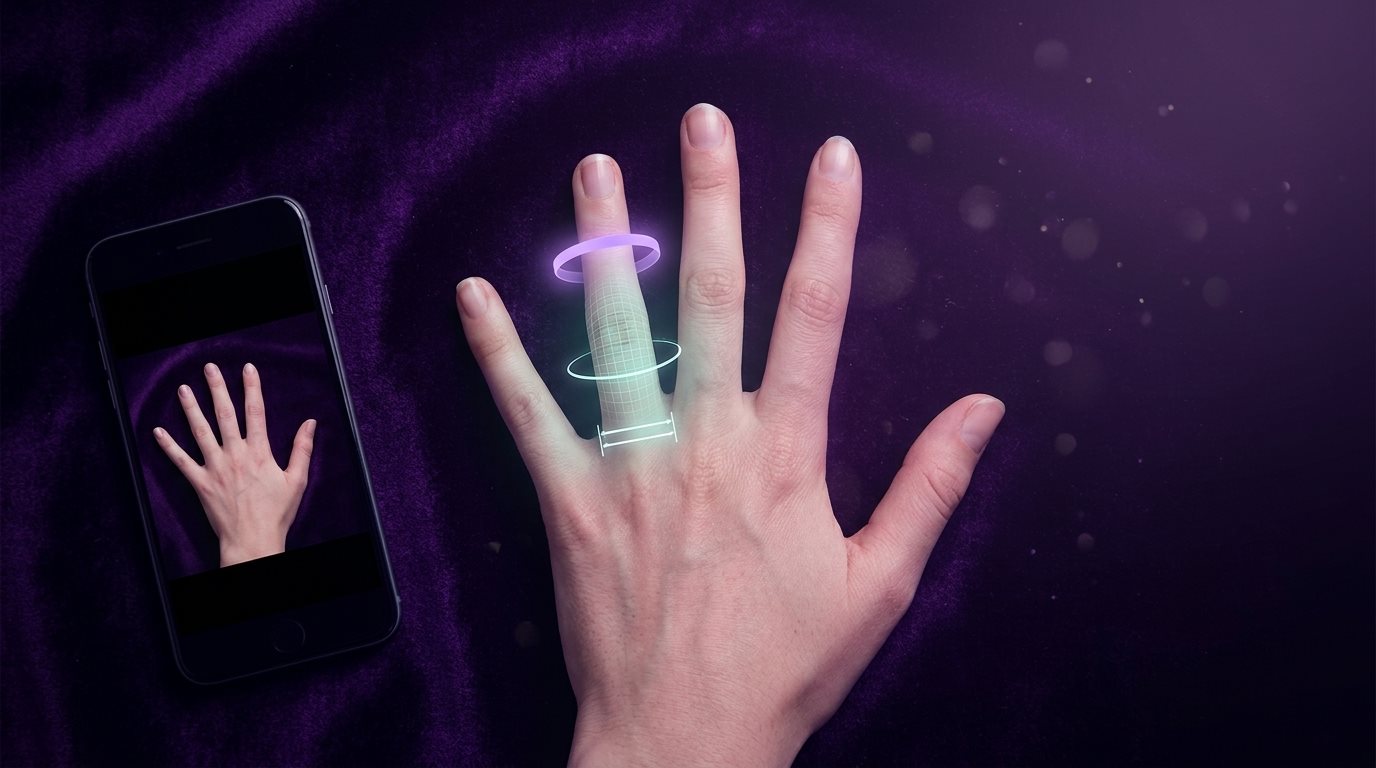
Short answer: it can get you close, but "close" and "exact" aren't the same thing.
When you upload a hand photo, the AI estimates your size instead of measuring your finger the way a tape measure would. It looks at things like finger length, knuckle size, and the distance between the phalanges (the finger bones), then compares that against a huge dataset of real hands to make its best guess.
Some tools go a layer deeper and specifically measure finger width at the base of the ring finger and knuckle width to convert that into a standard ring size.
The people who build this technology are refreshingly upfront about it too: it's challenging to determine an exact ring size from a picture alone, even with good algorithms behind it. So a virtual try-on is excellent for answering "does this style suit me?", but treat the size number it gives you as a strong starting point rather than a guarantee.
How Ring Size Gets Matched to Your Finger in a Virtual Try-On
It looks simple from your side (upload a photo, get a size), but there's a real process happening behind the scenes with ring try on.
First, the tool needs a reference point: something in the photo it already knows the real-world size of, so it can scale everything else against it. Some tools ask you to place your finger directly on your phone screen so it can measure width against the screen's known dimensions.
Others use a reference card in the photo alongside your hand for the same purpose. Photo-based tools without a physical reference instead rely on typical hand proportions and finger ratios learned from thousands of previous scans.
Once it has a scale to work from, it maps out the edges of your finger by measuring the distance between two points, based on differences in color, contrast, and brightness between your hand and the background. It calculates a diameter from that, then matches the diameter against a stored size chart to give you an estimated ring size in whatever format you need (US, UK, EU, or otherwise).
Using a Ring Size Chart to Set the Right Scale
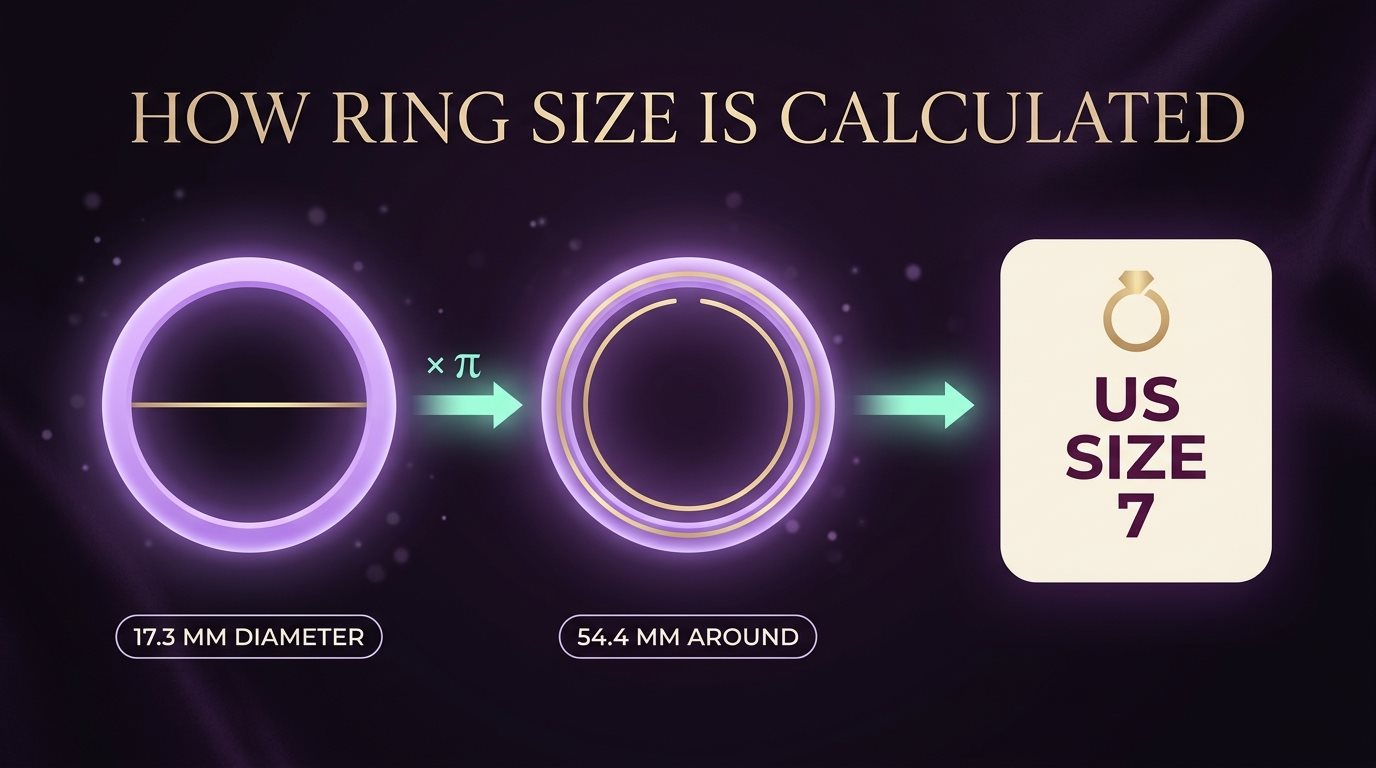
A ring size chart is the missing link between "here's a measurement in millimeters" and "here's a size you can actually order." Ring sizes are ultimately based on two numbers, inner diameter and circumference, and circumference is just diameter multiplied by pi. Once a tool knows the diameter, the chart does the conversion.
Here's how the most common sizes line up:
- US 4: 14.9 mm across, 46.7 mm around (UK/Australia H, Japan 7)
- US 4.5: 15.3 mm across, 48.0 mm around (UK/Australia I, Japan 8)
- US 5: 15.7 mm across, 49.3 mm around (UK/Australia J½, Japan 9)
- US 5.5: 16.1 mm across, 50.6 mm around (UK/Australia K½, Japan 10)
- US 6: 16.5 mm across, 51.8 mm around (UK/Australia L½, Japan 11)
- US 6.5: 16.9 mm across, 53.1 mm around (UK/Australia M½, Japan 13)
- US 7: 17.3 mm across, 54.4 mm around (UK/Australia N½, Japan 14)
- US 7.5: 17.7 mm across, 55.7 mm around (UK/Australia O½, Japan 15)
- US 8: 18.1 mm across, 56.9 mm around (UK/Australia P½, Japan 16)
- US 8.5: 18.5 mm across, 58.2 mm around (UK/Australia Q½, Japan 17)
- US 9: 18.9 mm across, 59.5 mm around (UK/Australia R½, Japan 18)
Source: Walker Metalsmiths
This matters more than people expect, because sizes can vary slightly depending on the manufacturer. So even an accurate diameter measurement can land you between two sizes, and different brands might round that differently. If you're ever stuck exactly between two sizes on a chart, the safer move is almost always to size up rather than down, since a slightly loose ring is a quick fix and a ring that doesn't fit at all is a bigger hassle.
What Makes a Virtual Ring Look True to Size?
A handful of quiet technical details separate a convincing, accurately-scaled preview from one that just looks vaguely ring-shaped and stuck on top of a photo.
A genuine reference point matters most. Whether it's a card in the frame, a known screen dimension, or a well-calibrated estimate from finger proportions, the tool needs something concrete to scale against. Without it, every measurement afterward is a guess dressed up as a number.
Good lighting and a clean background help the edge detection. Since the system is essentially reading the boundary between your finger and whatever's behind it based on contrast and brightness differences, a busy background or harsh shadows can throw that measurement off before it even gets to the sizing step.
Hand position needs to be consistent. Most tools want your hand flat, fingers spread, no rings already on, and photographed straight-on. If you deviate from that, the proportions the AI is reading start to skew.
Virtual Ring Size vs. Actual Ring Fit: What's the Difference?
The distinction worth sitting with is that virtual sizing estimates a number, while actual fit is a feeling.
A virtual tool can tell you "you're roughly a US size 7" based on your finger's proportions in a photo. What it can't tell you is how that size 7 ring feels once it's on: whether it glides over your knuckle a little too easily and might spin around, whether it feels snug in a way that's comfortable or a way that's tight, or how your finger's size shifts throughout the day.
Fingers change size with temperature and time, which is part of why size guides often advise measuring in the evening at room temperature. Fingers run slightly larger then, which helps make sure the ring fits comfortably all day.
So think of it this way: virtual size is your best-informed guess before you buy, and actual fit is the real-world confirmation that only happens once the ring is physically on your hand.
How to Get a More Reliable Ring Preview at Home
A few habits meaningfully improve how trustworthy your virtual size estimate ends up being:
Use good, even lighting. Natural daylight beats a dim room or harsh overhead light, since the AI needs clean contrast to find your finger's edges accurately.
Keep your hand flat, fingers spread, and free of existing rings. Anything covering or compressing your finger throws off the true measurement.
Shoot straight-on instead of at an angle. An angled photo distorts proportions in ways that are hard for the AI to correct for.
Try more than once. Take multiple measurements and check that you're getting consistent results before trusting the number.
Measure in the evening if you're doing a manual check alongside the virtual one. Fingers run slightly larger later in the day, which gives you a more realistic all-day fit than a morning-only snapshot.
What You Should Check Before Ordering Your Actual Ring
Before you place an order based on a virtual size estimate, a few final checks are worth the extra few minutes:
Cross-check against a printed or physical ring sizer if you have access to one. Two independent methods agreeing gives you real confidence, and two methods disagreeing tells you to slow down and dig deeper.
Check the retailer's specific size chart instead of a generic one. Since sizes can shift slightly between manufacturers, always confirm against the exact brand you're buying from.
Look at the return and resizing policy before you buy. Even a well-estimated size can end up needing a small adjustment, and knowing the resizing process upfront saves a headache later.
When in doubt, size up slightly. A ring that's a touch loose is a much easier fix than one that doesn't go on at all.
Final Word
A virtual ring try-on does one thing really well: it answers the visual question. Does this style suit you, does the stone catch the light, and does the metal work with your skin tone? That used to take a store visit, and now it takes a photo.
Size is a different job, though, because even good AI is estimating rather than measuring with certainty.
So use the preview to fall in love with the right ring. Then, before you order, take one more minute to confirm the size with a physical sizer, your jeweler, or the retailer's chart. That one step is the difference between a ring that looks perfect in a photo and one that actually feels right on your hand.
FAQs
Can a virtual ring try-on tell me my ring size?
Yes, most tools can give you an estimated size based on your finger's proportions in a photo. Treat it as a strong starting point rather than a final, guaranteed number.
How accurate is virtual ring sizing?
It varies by method. AI-camera tools are fast and generally reliable for narrowing down your range, but physical methods like a caliper measurement remain the most precise option available.
Can I use a ring size chart with a virtual try-on?
Yes. Most virtual sizing tools use a chart behind the scenes to convert your measured finger diameter into a standard size like US, UK, or EU.
Can a hand photo be used to estimate ring size?
Yes. The AI analyzes finger width, knuckle size, and overall proportions from the photo, then compares that data against known hand measurements to estimate your size.
Is virtual ring sizing accurate enough to order a ring?
It's accurate enough to get you very close, especially with a good photo and proper lighting. For a big purchase, it's still worth confirming with a physical sizer or a jeweler before finalizing.
Find Your Perfect Ring in Seconds
Stop guessing and start seeing. Our AI-powered virtual ring checker analyzes your preferences to reveal the perfect diamond for you. It's fast, fun, and finds your fit.
Try Our AI Checker Now