
If you're new to diamond shopping, you may have noticed the term IGI certified diamond popping up everywhere in product listings and diamond descriptions. You'll often see it mentioned alongside details such as carat weight, color, clarity, and cut. But why do sellers highlight it so often? Does it really make a difference when buying a diamond?
These are good things to know before spending your money. IGI examines diamonds and provides grading reports that describe their key characteristics. Once you understand what these reports tell you, comparing diamonds and knowing what you're paying for becomes much easier. So, let's look at what IGI certification means, what's included in its reports, and what to check before buying.
What Are IGI Certified Diamonds?
IGI stands for the International Gemological Institute. It's an independent gemological laboratory that examines diamonds, identifies their characteristics, and issues reports documenting its findings.
When a seller describes stones as IGI-certified diamonds, it means that IGI has examined them and issued grading reports for each stone. These reports record details about the diamonds, including their origin, shapes, measurements, carat weights, colors, clarity grades, and cut grades.
One small detail is worth understanding here. People commonly use the word certificate when talking about diamond reports, but a grading report is more accurately a professional assessment of a particular stone. It isn't a guarantee of the diamond's resale value, a price appraisal, or a promise that every buyer will agree with the grades.
IGI examines both natural and lab-grown diamonds. Its reports help identify the type of diamond and document its characteristics according to the relevant grading process. This gives buyers useful information to consider before purchasing.
Why Do So Many Online Diamond Listings Mention IGI?
If you've browsed online diamond stores, you've probably noticed that many listings include an IGI report number or mention IGI grading. This is particularly common in listings for loose lab grown diamonds.
The reason is fairly straightforward. Online shoppers can't pick up a diamond, examine it under a loupe, or compare it with another stone in person. They have to rely on product photographs, videos, specifications, and supporting documents.
An IGI report gives them a set of details to review. For example, someone comparing two 1-carat diamonds can check their color, clarity, cut, measurements, and other grading information. This makes it easier to understand what each listing is offering.
IGI also provides grading services for laboratory-grown diamonds. Its lab-grown reports identify the stone as laboratory-grown and document its characteristics. This makes IGI reports particularly relevant to online stores that sell lab-grown stones.
You may also find IGI reports with natural diamonds. The laboratory offers separate reporting services for natural and lab-grown stones, so it's important to check the description on the actual report.
In short, the report gives online buyers more information to work with. It also gives sellers a document they can share when explaining a diamond's listed specifications.
Reading an IGI Report Without Getting Lost in the Details
An IGI report can look a little technical at first, especially if you're seeing one for the first time. You'll find several grades, measurements, abbreviations, and diagrams on the page.
You don't need to understand every technical detail immediately. Start with the information that has the biggest effect on a diamond's appearance and overall quality.
Carat weight
Carat tells you how much a diamond weighs. One carat equals 200 milligrams. A higher carat weight generally means a heavier diamond, but the stone won't automatically look larger from the top. Its measurements and proportions also affect its visible size.
For example, two round diamonds with the same carat weight can have slightly different face-up measurements. One may appear larger because more of its weight is spread across its width rather than concentrated in its depth.
Color grade
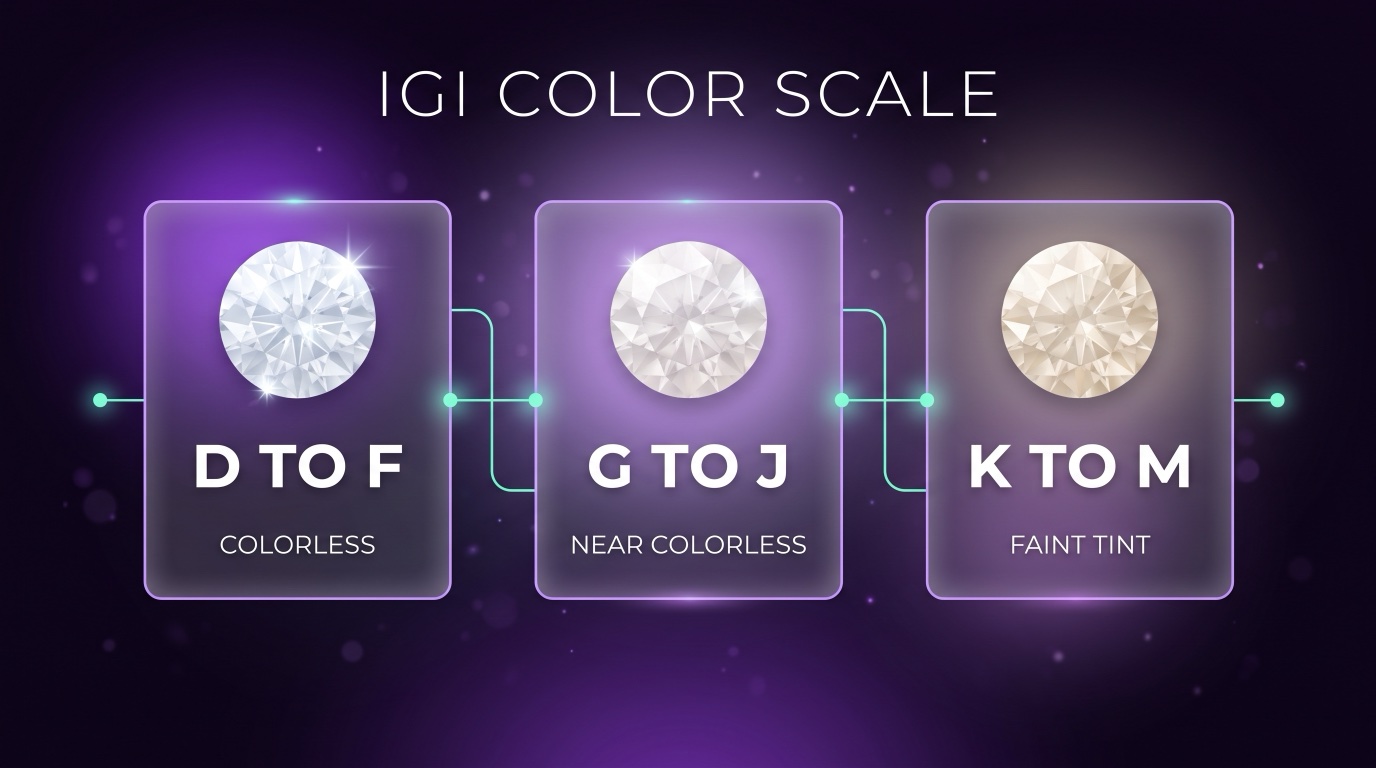
For diamonds in the standard D-to-Z color scale, the color grade describes how much yellow or brown tint is visible.
- D to F means colorless.
- G to J means near colorless.
- K to M means a faint tint is more noticeable.
- Lower grades indicate increasingly visible color.
A higher color grade usually costs more, but the difference between neighboring grades can be difficult to notice without comparing the stones side by side. The diamond's shape, setting, and metal color can also affect how its color looks when worn.
Source: IGI
Clarity grade
Clarity describes the internal features and surface marks found in a diamond. Internal features are called inclusions, while surface characteristics are known as blemishes.
IGI assesses clarity at 10x magnification. Its grading scale includes categories such as Internally Flawless (IF), Very Very Slightly Included (VVS), Very Slightly Included (VS), Slightly Included (SI), and Included (I).
A VS diamond, for example, may have small inclusions that are difficult to notice without magnification. An SI diamond may have more visible characteristics, depending on their size, position, and nature.
A lower clarity grade doesn't automatically make a diamond unattractive. The important thing is to understand where its inclusions are and whether they're visible to the naked eye.
Cut grade
Cut has a major influence on how a diamond handles light. It affects the brightness, sparkle, and flashes of color you see when the stone moves.
For round brilliant diamonds, IGI assesses proportions, polish, and symmetry when determining the cut grade. Its grading scale includes grades such as Excellent-Ideal, Excellent, Very Good, Good, Fair, and Poor.
Fancy shapes, such as oval, pear, and emerald cuts, have different assessment considerations. Check the report carefully because the cut grading options and information can vary by shape.
Measurements and proportions
The measurements show a diamond's dimensions, usually in millimeters. For a round diamond, you'll generally see its minimum and maximum diameter followed by its depth.
The proportions section may also include details such as table percentage, depth percentage, crown angle, pavilion angle, and girdle thickness.
These details help explain how the diamond is shaped. They can also help you compare stones with the same carat weight and cut grade.
Polish, symmetry, and fluorescence
Polish describes the smoothness of a diamond's surface after cutting. Symmetry refers to how evenly its facets are arranged and aligned.
Both can influence the stone's finish and appearance. Their grades are usually listed separately in the report.
Fluorescence describes how a diamond reacts to ultraviolet light. Some diamonds show a blue glow under UV light, while others may display a different fluorescence color or none at all. The report may record its strength, such as faint, medium, strong, or very strong.
How IGI Handles Natural and Lab Grown Diamonds
Natural and lab-grown diamonds are both real diamonds. They have essentially the same chemical composition, crystal structure, and physical properties. The main difference is where and how they form. Our honest guide to lab-grown diamonds explains how they're made and how they compare with natural stones.
Natural diamond reports
An IGI natural diamond report identifies the stone as a natural diamond. It includes information such as shape, measurements, carat weight, color, clarity, and cut assessment.
Depending on the report format, you may also find a proportions diagram, a clarity plot, and additional comments.
Lab-grown diamond reports
An IGI laboratory-grown diamond report identifies the stone as laboratory-grown. It also documents its shape, measurements, carat weight, color, clarity, and cut assessment.
Some reports may include additional information about the growth process and any treatments, when requested or applicable.
There is another detail worth checking. IGI states that every laboratory-grown diamond it grades receives a laser inscription identifying its lab-grown origin. Natural diamonds may also have report-number inscriptions, usually applied by request.
Checking an IGI Report Before You Pay
Once you've found a diamond you like, take a few minutes to check its report. It's a simple step that helps confirm you're looking at the correct document and stone.
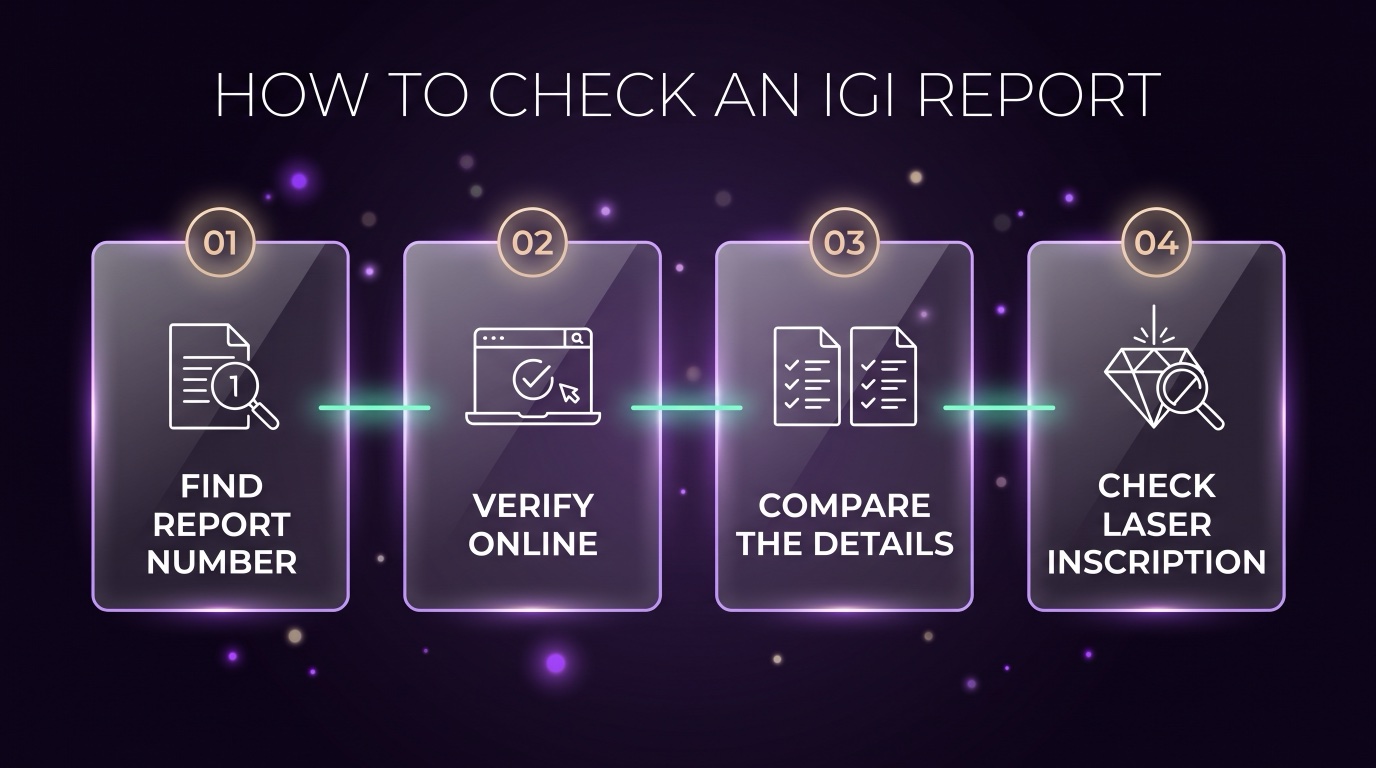
Here's what to do.
Start with the report number. Every IGI report has a unique identification number. Ask the seller for the number if it isn't already included in the listing.
Check the report online. Visit the official IGI report verification page and enter the report number. You can also scan the QR code on the report if one is available.
Compare the online details with the seller's listing. Check the diamond's shape, carat weight, color, clarity, measurements, and origin. These details should match the report.
Look for the laser inscription. If the diamond has a report number inscribed on its girdle, ask the seller to confirm that it matches the report. A jeweler can usually check the inscription under magnification.
Keep in mind that the presence of an inscription alone doesn't prove that a stone matches every detail in a report. The report number, inscription, and physical diamond should all be checked together.
If the diamond is already set in a ring, checking the inscription may be more difficult. The setting can cover part of the girdle, so ask the jeweler how the stone's identity was confirmed.
Does an IGI Report Make a Diamond a Better Buy?
An IGI report helps you make a more informed choice, but it doesn't guarantee that you're getting a good deal. It gives you important details about the diamond, such as its carat weight, color, clarity, and cut, so you can compare different stones more easily.
Still, don't base your decision on the report alone. Two diamonds with similar grades can look different and have different prices. Take a closer look at the actual stone, compare its price with similar diamonds, and check the seller's return policy.
In the end, the report helps you understand what you're buying. The diamond's appearance, asking price, and the seller's terms will help you decide if it's worth the money.
Final Word
So, now you know what an IGI certified diamond report tells you and what to look for when comparing diamonds. The next step is finding a stone and ring style that feel right for you. Want to see how your favorite design looks on your hand? Visit our virtual ring try-on tool, upload your photo, pick a style, and preview it on your finger. A preview shows how a ring looks, but it can't tell you its comfort, weight, or exact size, so get properly sized by a jeweler before you buy.
FAQs
Are IGI diamonds real diamonds?
IGI grades both natural and lab-grown diamonds. Both are real diamonds with essentially the same chemical and physical properties. The main difference is their origin, which the IGI report clearly identifies.
Can you trust an IGI diamond report?
An IGI report gives you useful details about a diamond's carat weight, color, clarity, cut, and origin. It helps you understand what you're buying, but always verify the report number and check that its details match the actual stone.
Does IGI grade loose lab-grown diamonds?
IGI grades loose lab-grown diamonds and issues reports identifying them as laboratory-grown. You'll find details such as carat weight, color, clarity, cut, shape, and measurements, making it easier to compare different stones.
Is an IGI report enough when buying an engagement ring?
The report tells you a lot about the diamond, but take time to look at the actual stone too. Check its sparkle, visible inclusions, and size. Also, review the ring setting and the seller's return policy before placing your order.
Can you verify an IGI report online?
You can check it through IGI's official report verification page. Enter the report number and compare the details with the seller's listing. If the diamond has a laser inscription, check that number too.
Find Your Perfect Ring in Seconds
Stop guessing and start seeing. Our AI-powered virtual ring checker analyzes your preferences to reveal the perfect diamond for you. It's fast, fun, and finds your fit.
Try Our AI Checker Now