You've settled on an oval. It looks elegant, it reads big for its weight, and it's one of the most requested shapes around. In The Knot's 2024 Jewelry and Engagement Study, ovals made up 25% of engagement ring center stones, second only to rounds. Now comes the harder question: 1.5 carats or 2?
On paper, a half carat sounds like a lot. On your finger, the gap is smaller than most people expect, and the price gap is bigger. That mismatch is why the 1.5 vs 2 carat oval diamond ring decision deserves a closer look before you pay for it. If you'd like to see both sizes on your own hand first, our virtual ring try-on lets you preview them from a single photo.
In this guide, we'll compare the real size of each stone in millimeters, explain why prices jump at 2 carats, cover the shape details that matter more than weight, and help you decide which one suits your hand and budget.
Let's get into it!
How Big Is a 1.5 vs 2 Carat Oval Diamond Ring, Really?
Carat measures weight, not size. GIA defines one metric carat as 200 milligrams, which is 0.2 grams. So a 2 carat diamond weighs a third more than a 1.5 carat one, but that doesn't mean it looks a third bigger.
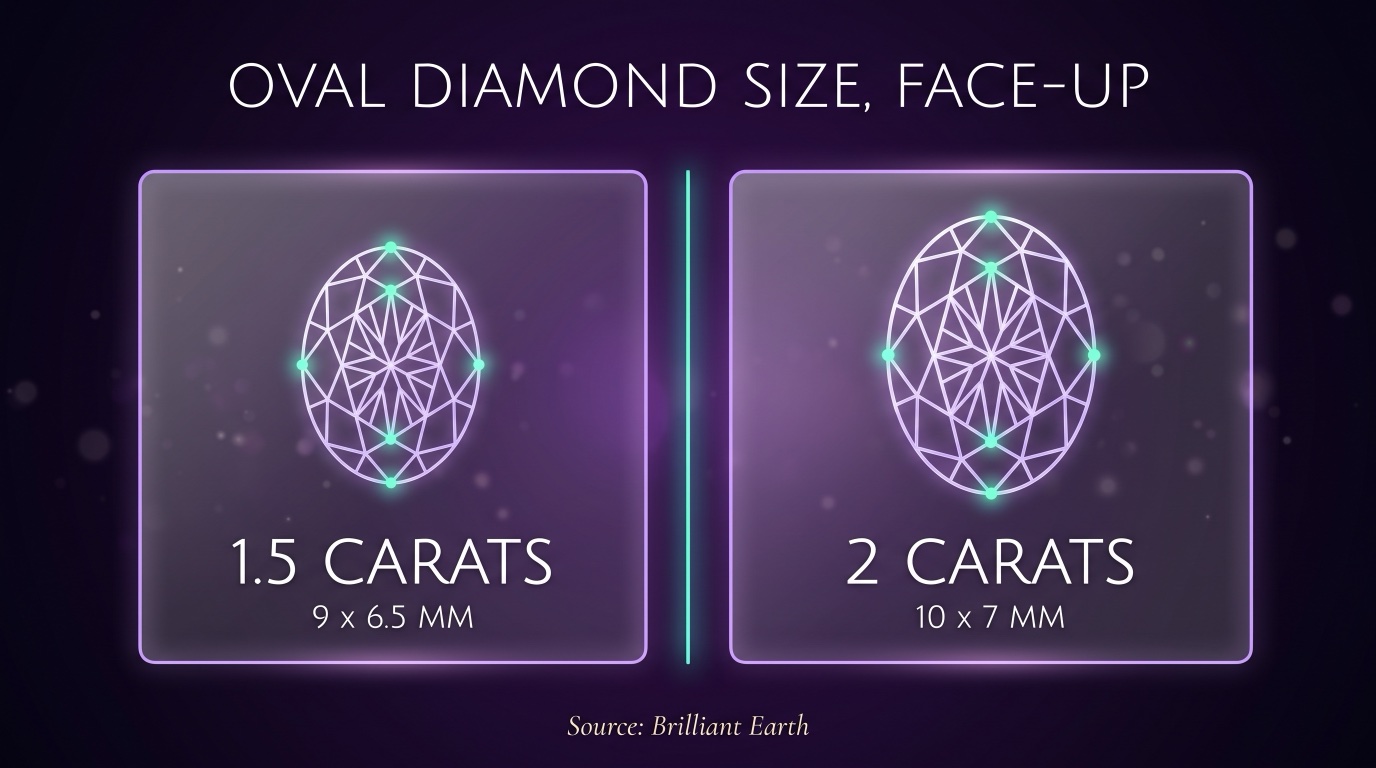
What you see when you look down at a ring is the face-up outline. According to Brilliant Earth's oval size chart, a typical 1.5 carat oval measures about 9 x 6.5 mm, and a typical 2 carat oval measures about 10 x 7 mm. That's 1 mm longer and half a millimeter wider.
Source: Brilliant Earth
If you work out the face-up area from those measurements, the 2 carat oval covers roughly 20% more surface than the 1.5 carat. You're paying for 33% more weight and getting about a fifth more visible diamond. The difference is real and you'll notice it side by side, but on its own, many people find a well-cut 1.5 carat oval looks every bit as generous.
Keep in mind that these are typical sizes. Two ovals of the same weight can measure differently depending on how they were cut, which is why the measurements on a grading report tell you more than the carat number alone.
Why Does the Price Jump So Much at 2 Carats?
Diamond prices don't climb in a straight line. GIA explains that the price increase with carat weight isn't linear but exponential, so a 2 carat stone costs more than its extra weight alone would suggest, even at the same quality.
There's a second effect on top of that. GIA lists 1.00, 1.50 and 2.00 carats as "magic sizes" because buyers want those round numbers, and it notes that diamonds at or just above a magic size are generally more expensive per carat. A stone that weighs 1.90 carats can look almost identical to a 2.00 carat stone while costing noticeably less.
How to Use Magic Sizes to Your Advantage
If you love the look of a 2 carat oval but the price makes you wince, ask to see stones a few points under, such as 1.90 to 1.97 carats. GIA itself suggests choosing a stone a few points below a magic size to save money. The same idea works around 1.5 carats, where a 1.45 carat oval can come in under a 1.50.
Lab-grown diamonds change the math too. They're priced far below natural stones of the same size, so a 2 carat lab-grown oval may cost less than a 1.5 carat natural one. Our guide to lab-grown diamonds covers the price and resale trade-offs in detail.
Which Oval Shape Details Matter More Than Carat?
With ovals, two stones of the same weight can look surprisingly different. Before you decide between 1.5 and 2 carats, check these details, because they can change how big and bright the diamond appears.
Length-to-Width Ratio
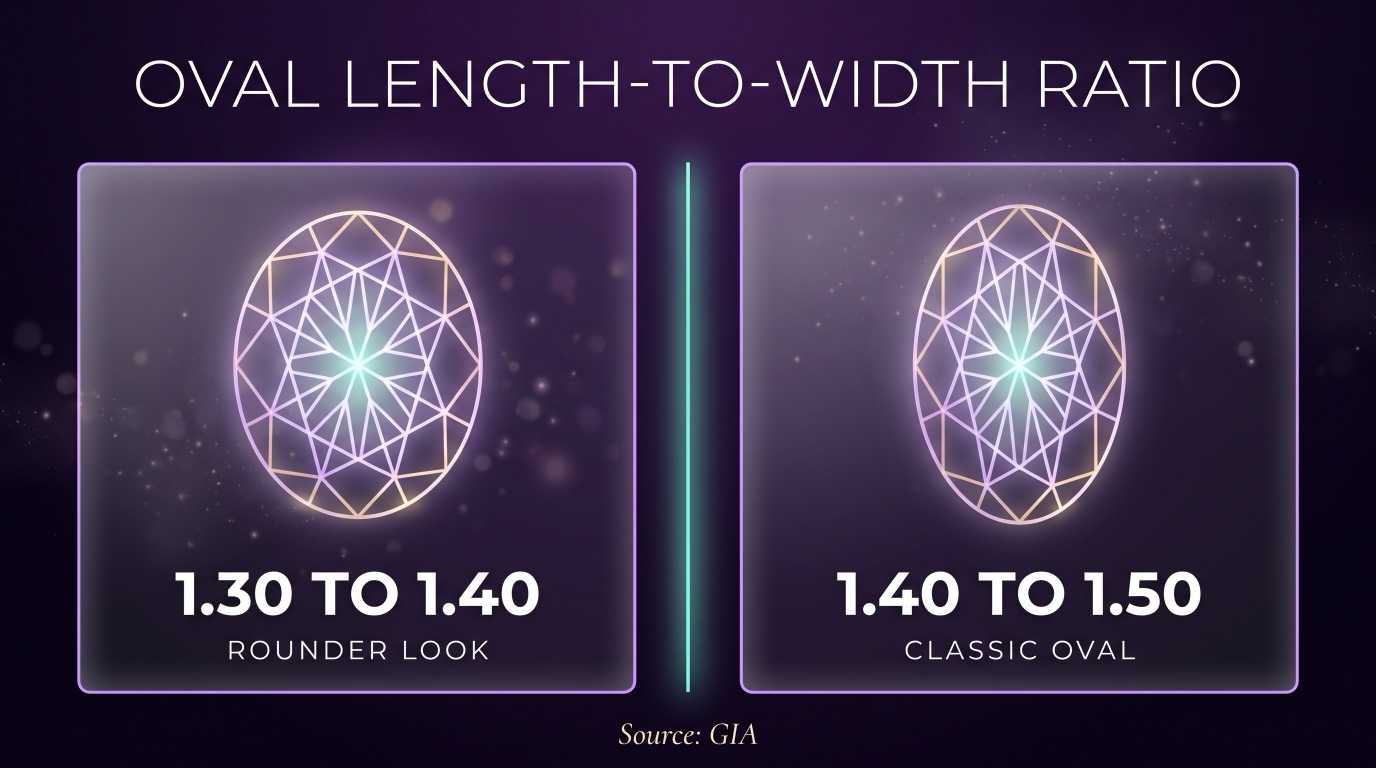
The length-to-width ratio decides whether an oval looks plump or slender. GIA's oval diamond guide suggests a ratio between 1.30 and 1.40 for a rounder look and 1.40 to 1.50 for a more traditional oval. A longer, slimmer oval also looks bigger from above, so a 1.5 carat with a 1.50 ratio can look a little larger than its weight suggests.
Source: GIA
The Bow-Tie Effect
Many ovals show a darker band across the middle that looks like a bow tie. GIA explains that it happens when part of the light entering the stone is blocked. A faint bow tie is normal and can add contrast, but a heavy one makes the center look dull. Look at photos or videos of the actual stone rather than relying on the grades.
No Overall Cut Grade
Many shoppers don't realize that GIA only gives an overall cut grade to round brilliant diamonds, so an oval's report won't tell you whether it's well cut. You'll need to judge the shape, the bow tie and the sparkle with your own eyes. Our guide to GIA certified diamonds explains what the report does include.
How Do You Choose the Right Size for Your Hand?
When you weigh a 1.5 vs 2 carat oval diamond ring, remember that the same stone can look modest on one hand and huge on another, so think about your fingers as well as your budget.
Slender or shorter fingers: A 1.5 carat oval often looks full and balanced. A 2 carat can cover most of the finger's width, which some people love and others find heavy.
Longer or fuller fingers: A 2 carat oval keeps its presence without looking oversized. If you're choosing 1.5 carats, a slimmer band or a slightly longer ratio can help it hold its own.
Your setting: A thin solitaire band makes the center stone look larger by contrast, while a halo adds visible size around it. Our guide to engagement ring settings shows how each style changes the look.
Daily life: A bigger oval sits higher and wider, so it's more likely to catch on gloves, hair or knits. If you work with your hands, a lower setting helps with either size.
Can You Compare the Two Sizes Before You Buy?
Seeing both rings on your own hand is the most reliable way to decide, and you don't have to visit a store to get a first impression. With our virtual ring try-on, you upload a photo of your hand, choose an oval ring from the gallery or upload a photo of the exact ring you're considering, and the AI places it on your finger in seconds.
To compare sizes, generate one preview with a 1.5 carat ring and another with a 2 carat ring, then look at them side by side. The tool doesn't read carat weight from a listing, so use the size control to make the 2 carat ring a little longer and wider, based on the measurements above, and adjust its position so it sits naturally on your finger. Each preview uses one credit, so pick the two or three rings you're most serious about.
What a Preview Can and Can't Tell You
A virtual preview is great for judging proportion and style, but it has limits. It shows the look, not comfort, weight or your exact ring size, and it can't show real sparkle or grade a diamond. The scale is a close visual guide rather than a millimeter-perfect measurement, so treat it as a way to narrow down your choice.
Before you buy, get your finger properly sized by a jeweler, check the stone's report and measurements, and look at real photos or videos of the specific diamond. If you can, try a similar ring on in person to feel its height and weight.
Final Word
In the 1.5 vs 2 carat oval diamond ring debate, the 2 carat gives you about a fifth more visible diamond, but it usually costs far more than that difference suggests. If budget matters, a well-cut 1.5 carat with a flattering ratio, or a stone just under 2 carats, can give you most of the look for less. If you've always pictured a 2 carat, and the numbers work, it's a beautiful choice.
The easiest way to settle a 1.5 vs 2 carat oval comparison is to see both on your hand. Upload a photo to our virtual ring try-on, try a 1.5 and a 2 carat oval, and compare them before you commit. A preview shows how a ring looks, but it can't tell you its comfort, weight, or exact size, so get properly sized by a jeweler before you buy.
FAQs
Is a 2 carat oval much bigger than a 1.5 carat oval?
It's noticeable but not dramatic. Typical sizes are about 9 x 6.5 mm for 1.5 carats and 10 x 7 mm for 2 carats, which works out to roughly 20% more visible surface for a third more weight.
Why is a 2 carat diamond so much more expensive?
Diamond prices rise faster than carat weight, and 2.00 carats is one of GIA's "magic sizes" that buyers pay a premium for. Choosing a stone a few points under 2 carats can lower the price without a visible change in size.
What is the best length-to-width ratio for an oval diamond?
GIA suggests 1.30 to 1.40 for a rounder look and 1.40 to 1.50 for a classic oval. The best ratio is the one you like, so compare a few shapes in photos before you choose.
Does an oval look bigger than a round diamond of the same carat?
An oval usually looks bigger, because GIA notes that an oval's elongated shape gives it a larger surface area than a round diamond of the same carat weight, so it tends to look bigger from above.
Should I choose a lab-grown oval to get 2 carats?
It's an option if size matters most to you, since lab-grown diamonds cost much less than natural ones of the same weight. They do have far lower resale value, so weigh that against the savings.
Find Your Perfect Ring in Seconds
Stop guessing and start seeing. Our AI-powered virtual ring checker analyzes your preferences to reveal the perfect diamond for you. It's fast, fun, and finds your fit.
Try Our AI Checker Now